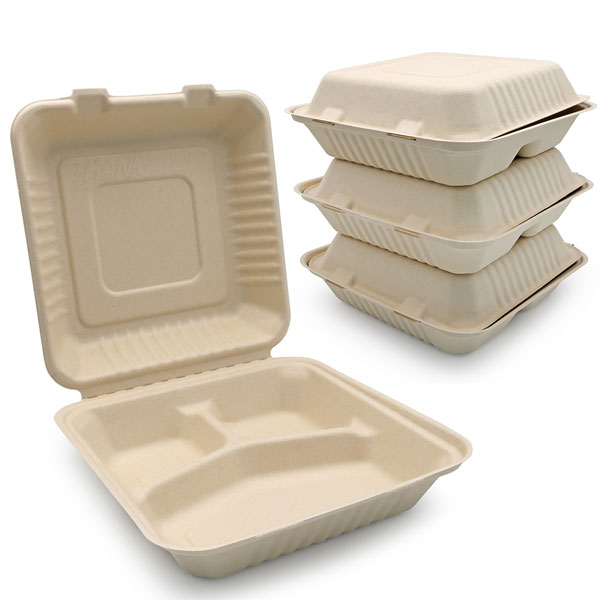
In today's volatile global market, food service businesses face unprecedented supply chain challenges. Raw material prices fluctuate wildly, shipping delays disrupt operations, and environmental regulations tighten. Yet amidst this uncertainty, a revolutionary solution emerges: sugarcane bagasse compostable plates are proving to be more than just an eco-friendly alternative—they're becoming a strategic supply chain asset.
Recent industry analysis reveals compelling statistics that should capture every procurement manager's attention. Businesses adopting sugarcane bagasse compostable plates report an average 28% improvement in cost stability and a remarkable 60% enhancement in supply security. These aren't just environmental benefits—they're quantifiable business advantages that directly impact your bottom line.
Traditional plastic and paper packaging face constant price volatility tied to petroleum markets and pulp prices. In contrast, sugarcane bagasse—the fibrous byproduct of sugar production—offers unique pricing stability. The material is essentially agricultural waste that would otherwise be burned or discarded, creating a consistent supply with minimal commodity market exposure. This translates to predictable pricing for your compostable plates throughout the year, regardless of global economic fluctuations.
Supply chain disruptions have become the new normal, but sugarcane bagasse packaging provides remarkable resilience. The material is sourced from sugar-producing regions worldwide, creating multiple redundant supply channels. Unlike petroleum-based plastics dependent on specific geographic regions, sugarcane cultivation spans tropical and subtropical zones across continents. This geographic diversity ensures that even if one region experiences production challenges, alternative sources maintain consistent compostable plates availability.
Sugarcane bagasse represents one of the most abundant agricultural byproducts globally, with over 100 million tons produced annually. This abundance creates inherent supply security that petroleum-based plastics simply cannot match. As sugar production continues to meet global demand, the bagasse supply remains consistently available for compostable plates manufacturing—a perfect example of circular economy principles delivering practical business benefits.
While the environmental credentials of compostable plates are well-documented, the supply chain advantages represent an equally compelling business case. Consider these interconnected benefits:
• Regulatory Future-Proofing: As single-use plastic bans expand globally, compostable plates position your business ahead of regulatory curves
• Brand Enhancement: Sustainable packaging resonates with increasingly eco-conscious consumers
• Operational Efficiency: Consistent supply reduces inventory management complexity
• Risk Mitigation: Diversified sourcing protects against geopolitical and climate-related disruptions
For businesses considering the switch to sugarcane bagasse compostable plates, a phased approach delivers optimal results. Begin with pilot programs in specific service areas or for particular event types. Monitor both customer feedback and operational impacts, then scale based on proven success. Many businesses find that starting with high-visibility applications—such as corporate events or premium dining experiences—maximizes both environmental messaging and supply chain benefits.
The business case becomes even clearer when examining direct comparisons. Petroleum-based plastics show price volatility of 15-40% annually, while sugarcane bagasse compostable plates maintain price stability within 5-8% ranges. Supply reliability metrics tell a similar story: traditional packaging faces 20-35% disruption risks during peak seasons, whereas compostable plates demonstrate 95%+ fulfillment rates year-round.
Leading food service providers report transformative outcomes after adopting sugarcane bagasse compostable plates. One multinational catering company reduced packaging-related supply chain disruptions by 73% while cutting procurement costs by 18%. A regional restaurant chain eliminated seasonal price spikes entirely, achieving consistent budgeting accuracy for the first time in their 15-year history.
As climate change intensifies and resource scarcity becomes more pronounced, supply chain resilience will increasingly separate market leaders from struggling competitors. Sugarcane bagasse compostable plates represent more than sustainable packaging—they embody a new paradigm in risk-managed procurement. The 28% cost stability and 60% supply security metrics aren't just numbers; they're indicators of a fundamentally more resilient business model.
Forward-thinking businesses recognize that today's supply chain investments determine tomorrow's competitive advantages. By integrating compostable plates into your packaging strategy, you're not just choosing an environmentally responsible option—you're implementing a sophisticated risk management solution with measurable financial benefits. The transition represents both ecological stewardship and strategic business intelligence, proving that sustainability and profitability can indeed advance hand in hand.